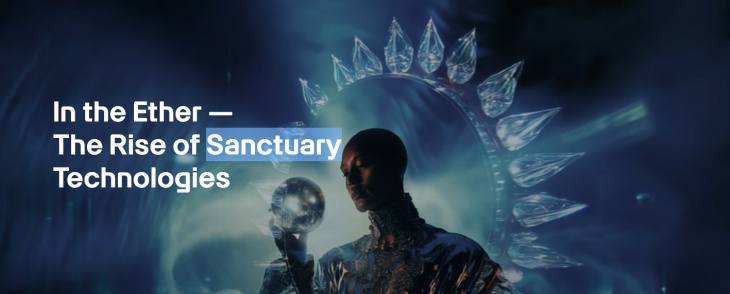
In the Ether is the third iteration of ArtScience Museum's festival that brings together science, technology, and society through art, installations, talks, and workshops.
This year's edition explores “sanctuary technologies”: ideas, practices, and experiments that use technology to give people greater choice and autonomy, allowing them to create and share knowledge responsibly, and support collective wellbeing. In this context “Sanctuary”, is not a place of retreat. It is a way of thinking about how technology might help people and communities adapt and thrive now and in the future.
The festival is structured around three themes Imagine, Investigate and Experiment. Imagine asks questions about the technologies we already live with and the directions of technological development we may choose to pursue. Investigate brings together real-world, research-driven projects that examine how technological systems operate, how they shape society, and what alternatives might emerge. Experiment turns to microchips and open-source hardware, whose designs are publicly available for anyone to study and build upon, exploring alternative approaches to designing and building technology from the ground up.
The festival brings together contributions from a diverse network of researchers, artists, and practitioners. These include perspectives from open-source technologists, including Vensa, a non-profit organisation advancing open-source microchips, Ethereum co-founder Vitalik Buterin, interviews with scientists from Nanyang Technological University's Centre for Computational Technologies for Finance (CCTF), and student projects supported by the Singapore University of Technology and Design's DIVE — Design.AI Innovation and Venture Exploration.
Image credits: Courtesy of Inhwa Yeom.
Drone in Search for a Four Leaf Clover, 2023
- Location: Level 1, Lobby
- Artist: Sputniko!
Image credits: Courtesy of the artist.
A drone equipped with image-recognition software searches a field for four-leaf clovers, automating a childhood treasure-hunt usually shaped by patience, chance, and close attention. By transforming a playful search for luck into a machine task, this artwork asks what may be gained—and what may be lost—when technology seeks to optimise even the smallest moments of everyday life.
Explore the Programmes
Distributed Memory: Building Shared Databases – workshop by Juan Cortés
- Date: 3 Oct, 10.30am – 1.30pm
- Location: ArtScience Laboratory, Ripple Room
- Free admission with registration
This practical workshop explores how cultural memory can be preserved through distributed digital systems rather than relying on a single institution, platform or server. Drawing on the experience of Colombia’s Virtual Museum of Historical Memory, participants will work with a small collection of images, recordings, documents or texts using the InterPlanetary File System (IPFS) platform.
Through a series of guided exercises, participants will create a small digital archive, prepare metadata, and learn how to make collections more accessible across different locations and communities. The workshop introduces the basic principles of decentralisation through direct experience, encouraging participants to consider both the possibilities and limitations of distributed archival systems.
Image credits:Rodrigo de la Fuente. Courtesy of the artist.
Machine Unlearning – workshop with Simon Weckert
- Date: 3 Oct, 3.30pm – 5.30pm
- Location: ArtScience Laboratory, Ripple Room
- Free admission with registration
This hands-on workshop introduces participants to the inner workings of contemporary artificial intelligence (AI) systems through the lens of artistic experimentation and critical practice. Starting with the fundamental components that shape machine learning models, participants will explore how AI systems can be questioned, manipulated and creatively repurposed. Rather than treating AI as a fixed technological tool, the workshop approaches it as a cultural and political system that can be investigated, challenged and transformed.
Through practical exercises, participants will gain a clearer understanding of how AI systems are trained, how they produce outputs, and how artists can intervene in these processes to reveal hidden assumptions, biases and limitations.
Image credits: Courtesy of the artist.
Open Chip Lab – Talks and Programmes
Workshops and talks
- Date: 3 Oct – 6 Dec
- Location: Various locations across ArtScience Museum
- Free admission with registration
A dynamic series of workshops and talks exploring open-source technologies led by practitioners working across the open-source ecosystem. Upcoming workshops include:
- Make Your Own Chip with Tiny Tapeout, 23 Nov, 1:00–5:00 PM, ArtScience Laboratory, Ripple Room
- Make Your Own Chip with Tiny Tapeout 27 Nov, 1:00–5:00 PM, ArtScience Laboratory, Ripple Room
- Make Your Own Chip with Tiny Tapeout 29 Nov, 1:00–5:00 PM, ArtScience Laboratory, Ripple Room
- Make Your Own Chip with Tiny Tapeout 1 Dec, 1:00–5:00 PM, ArtScience Laboratory, Ripple Room
Image Credit: ArtScience Museum
When
3 October - 6 December, See the website for the opening hours.
Age
0+
Price
Free
Links

Address
Singapore10 Bayfront Avenue, Singapore 018956